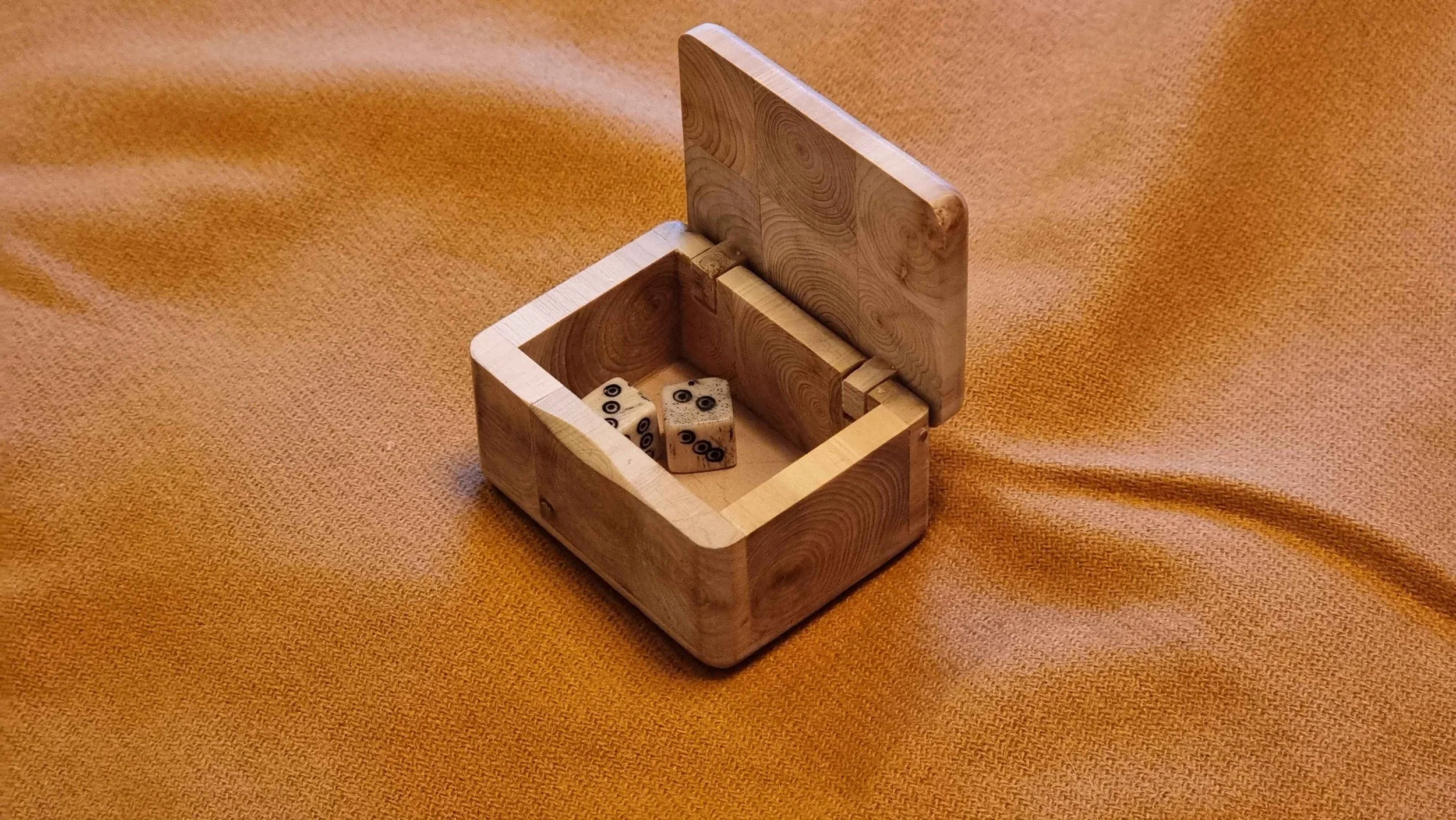
IF you are here you probably got a MIA Box!

My name is Patrik, but everyone calls me Fluffy. I reconstructed these Mia rules from an incomplete wiki article, and while it may not be exactly how it was intended to be played, the version I reconstructed has proven to be one of the greatest pocket games I have ever played.
This site is for my game studio, and here I intend to host some side projects that the studio members have done. You will be able to find my version of the Mia rules here as long as I’m able to host them.
If you see me at Medieval week, come up and say hi, or join me for a game of Mia!
The rules
Mia is a game about bluffing where you roll two dice in a closed box, and tell the next player in turn what the number “is”.
It could be considered the precursor to Liars Dice, but is much simpler and arguably has more depth.
Core rules
The core rule of Mia is: “You must always say a higher number when passing on the box”.
Dice Values
The highest die is always your tens number.
The lower dice is always your ones number.
This means that if you roll a 3 and a 1, it is always 31, never 13.
This makes the scale of numbers as follows
31, 32
41, 42, 43
51, 52, 53, 54
61, 62, 63, 64, 65
Double numbers are higher than normal numbers in declining order.
This gives us:
Double 6
Double 5
Double 4
Double 3
Double 2
Double 1
And the highest available is 21, also called a Mia.
Playing
Each player starts with 6 lives. If you want you can have an extra dice to remember your lives with.
The starting player starts a round by rolling the dice and saying a number as they pass the box to the player to their left.
A player taking possession of the box then decides to call or accept the number.
If the player taking possession accepts then they shake the box without looking at the dice, look at the dice, and then say a higher number than what was said when they took possession.
If the player decides to call then they look at the dice. If they are lower than the number said, then the player who sent the box loses a life and the player who took possession starts a new round by shaking the box.
If the dice are equal or higher than the number said then the player who called loses a life and hands the box to the next player in the circle, who then starts a new round.
If a player passes the box and say they have a Mia, the player taking possession has two different choices:
They either Accept that it’s a Mia, lose one life, and pass the box to the player to the left, who then starts a new round.
Or they call the Mia. However if it actually is a Mia, then the player that called loses 2 lives (instead of 1), and passes the box to the player to the left, who then starts a new round.
If they call and it is not a Mia, then the player who sent the box loses 1 life as normal.
A player who loses all lives is out, and drops out of the circle. The game ends when only 1 player remains.
Advanced Play
Here is a selection of more advanced ways of playing Mia that gives it the depth that makes it great. These aren’t optional rules, just ways of playing, adhering to the core rule “You must always say a higher number when passing on the box”.
Lie low
If people are getting good at telling if you are lying you can (if the opportunity presents itself) say a lower number than what your dice are showing (but still higher than what the previous player said). You will then technically be lying, but if they call, they lose a life as the dice are better than what you said.
No look shake
If you are just terrible at lying, you can always skip looking at your dice. Just shake them and pass it on. No one can tell if you are lying, as you don’t even know what the dice say! Statistically 54 is the median and you have a 50% chance of rolling higher.
No shake accept
If you think someone is lying lower than what their dice actually are, you can accept what they said, not shake, and then pass it on with a higher number said. By doing this you are accepting the risk and if you are called, then you still lose the life if it is lower than what you said.
Targeted high roll
If you have an opponent you’d like to target with a high roll, but that isn't sitting next to you then you can say a lower number than what your dice rolled, wink wink, nudge nudge the person next to you, and convince them that you are asking them to do a “No shake accept”. This is most commonly done with a Mia, as that has a natural end to incremental lying, ensuring the target takes the loss of life.